
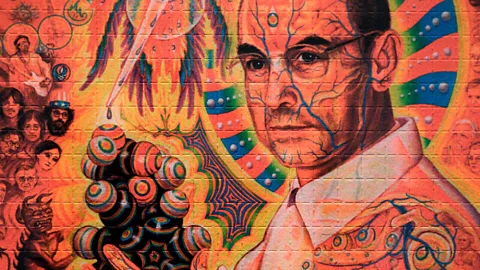
The Accidental High: Meet the Scientist Who Gave the World LSD
Few chemical compounds have shaped modern consciousness, medicine, and counterculture quite like Lysergic Acid Diethylamide (LSD). It has been hailed as a psychiatric breakthrough, condemned as a dangerous narcotic, and immortalized in countless songs, books, and artworks.
But behind the mythos of “acid tabs” and tie-dye stands one man: a quiet, dedicated Swiss chemist who stumbled upon the most potent mind-altering substance known to science.
Meet Dr. Albert Hofmann, the reluctant father of the psychedelic age.
From Ergot Fungi to Accidental Breakthrough
Albert Hofmann was neither a hippie nor a rebel. He was a dedicated researcher working at Sandoz Laboratories in Basel, Switzerland, in the 1930s. His goal was deeply conventional: synthesizing new compounds from ergot—a parasitic fungus that grows on rye—in the hope of developing useful pharmaceuticals, perhaps circulatory or respiratory stimulants.
In 1938, his efforts led him to synthesize a new substance: LSD-25. The “25” simply meant it was the twenty-fifth lysergic acid derivative he had created. Initial testing on animals showed that the compound caused unusual restlessness, but nothing immediately useful, so the new chemical was shelved and forgotten.
Five years passed.
The Moment of Discovery: April 16, 1943
For reasons that even Hofmann couldn’t fully explain later, he felt compelled to re-examine LSD-25 in the spring of 1943. While handling the substance, likely recrystallizing it for testing, a minuscule amount must have been absorbed through his fingertips.
What followed was perhaps the most consequential “accidental high” in history.
Hofmann described feeling a strange giddiness and restlessness, accompanied by a rapid flow of fantastic, vivid images. He had to stop work and go home, sinking into a dream-like state characterized by intense hallucinations. He realized that this extremely potent psychological effect must be linked to the compound he was handling.
He had become the first human being to experience an LSD trip.
Bicycle Day: The Infamous Ride
Hofmann knew he needed to confirm his findings. Three days later, on April 19, 1943, he decided to perform a deliberate self-experiment. Reasoning that the compound was likely highly potent, he chose what he believed was an incredibly small, safe dose: 250 micrograms (µg).
Spoiler alert: That dose was, and remains, enormous.
For context, a typical, modern recreational dose is often between 50 and 150 µg.
Hofmann began to feel the effects almost immediately. As the symptoms rapidly intensified, he asked his laboratory assistant to escort him home. Due to wartime restrictions on fuel, they had to make the journey on bicycles.
This journey—the first intentional, powerful LSD trip undertaken while navigating the city streets of Basel—is now famously celebrated every year as Bicycle Day.
Hofmann described the ride home as a dizzying plunge into altered reality:
“Everything in my field of vision swayed and was distorted as if seen in a curved mirror. I had the feeling I could not move from the spot, although my assistant later told me we had cycled vigorously.”
Once home, the environment became terrifyingly beautiful. Ordinary objects morphed, colors exploded, and he feared he was going insane. Yet, by the time the doctor arrived, the most acute phase was passing, and Hofmann was left with a powerful realization: he had discovered a drug that profoundly affected human consciousness at near-unimaginably low doses.
The Problem Child
Sandoz began marketing LSD in the 1950s under the trade name Delysid. The drug was intended strictly for psychiatric research, especially to aid psychoanalysis and study models of psychosis.
LSD did not remain confined to clinical settings for long. Through figures like Aldous Huxley and, later, the infamous Dr. Timothy Leary, the compound escaped the lab and fueled the countercultural explosion of the 1960s.
For Hofmann, this mass adoption was a source of great pain and frustration. He had intended his discovery to be a tool for understanding the human mind—a “medicine for the soul.” Instead, it became criminalized and demonized, preventing serious research for decades.
Hofmann often referred to LSD as his “problem child.”
A Life Dedicated to Understanding
Unlike so many others who were consumed by the psychedelic experience, Albert Hofmann remained a respected, sober scientist throughout his life. After his work with LSD, he went on to isolate psilocybin (the psychoactive compound in magic mushrooms) and other natural psychedelics.
He spent the subsequent decades advocating for the responsible use of psychedelics in therapeutic and spiritual contexts. He never regretted his discovery but lamented the government crackdowns that halted medical exploration.
Albert Hofmann lived to the extraordinary age of 102, passing away peacefully in 2008.
Today, as serious medical research into the potential of psychedelics for treating conditions like depression, PTSD, and addiction finally resumes across the globe, the visionary but accidental discovery made on a Swiss bicycle ride returns to the forefront of science—just as its founder intended.